The evidence layer for Australian AI
Your team is using AI.
Can you prove it was compliant?
Guard sits between your business and whatever AI model you use. Every call is checked against Australian regulation, signed as tamper-evident evidence, and logged for seven years.
Built for financial services, superannuation, health, insurance, government, and professional services. Covers CPS 234, CPS 230, the Privacy Act, and the ADM transparency obligation commencing December 2026. Live in a day.
$4,500 pilot fee, credited against year one. 60 days. No lock-in. Walk away with your data if it's not for you.

Compliance obligations already in force
—
days
CPS 234 §15
APRA-regulated entities have been required to actively oversee third-party systems — including AI — accessing customer data.
—
days
Privacy Act — APP 8
Cross-border disclosure obligations have applied to any business sending personal data to an overseas AI provider.
| Date | Entity | Regulatory citation | Amount |
|---|---|---|---|
| Oct 2025 | Australian Clinical Labs — first Privacy Act civil penalty | OAIC · APP 11.1 · failure to demonstrate adequate data protection controls | $5.8M |
| 2023 | Medibank Private — APRA capital adequacy increase | CPS 234 · inadequate information security controls and third-party oversight | $250M |
| May 2022 | RI Advice Group — Federal Court, breach of AFS licence obligations | ASIC · "inadequate cybersecurity documentation and controls" — court's own words | $750K+ |
In each case, the regulator asked the same question. Can you demonstrate your controls were active? Not whether you had a policy. Whether you had evidence.
And one more obligation on the horizon
10 December 2026 — automated decision-making transparency commences. Civil penalties up to $50 million. Guard generates the logs the disclosure describes.
Privacy and Other Legislation Amendment Act 2024 (Cth), Schedule 1, Part 15
THE GAP
Your policy says you control AI.
Can you prove it?
Your business has deployed AI via API, through claims triage, support bots, credit decisioning, RAG assistants, or features inside your own product. Provider logs aren't audit evidence. A syslog entry doesn't tell an auditor which obligation was assessed, which PII crossed a border, or whether controls were active at the moment of each call.
No visibility
Staff and application code hit OpenAI, Anthropic, Azure AI, and Bedrock directly. Network logs capture the destination, not the content. Your SIEM sees a connection, not a compliance event.
A clock, not a deadline
CPS 234 gives 72 hours to notify APRA of a material incident. Privacy Act entities have 30 days under the NDB scheme. Without per-call evidence, neither window is easy to meet.
Risk accumulating
Every week without instrumentation is another week of AI activity you can't retroactively attest. The auditor sees what was evidenced, not what was promised.
40° South is the evidence layer.
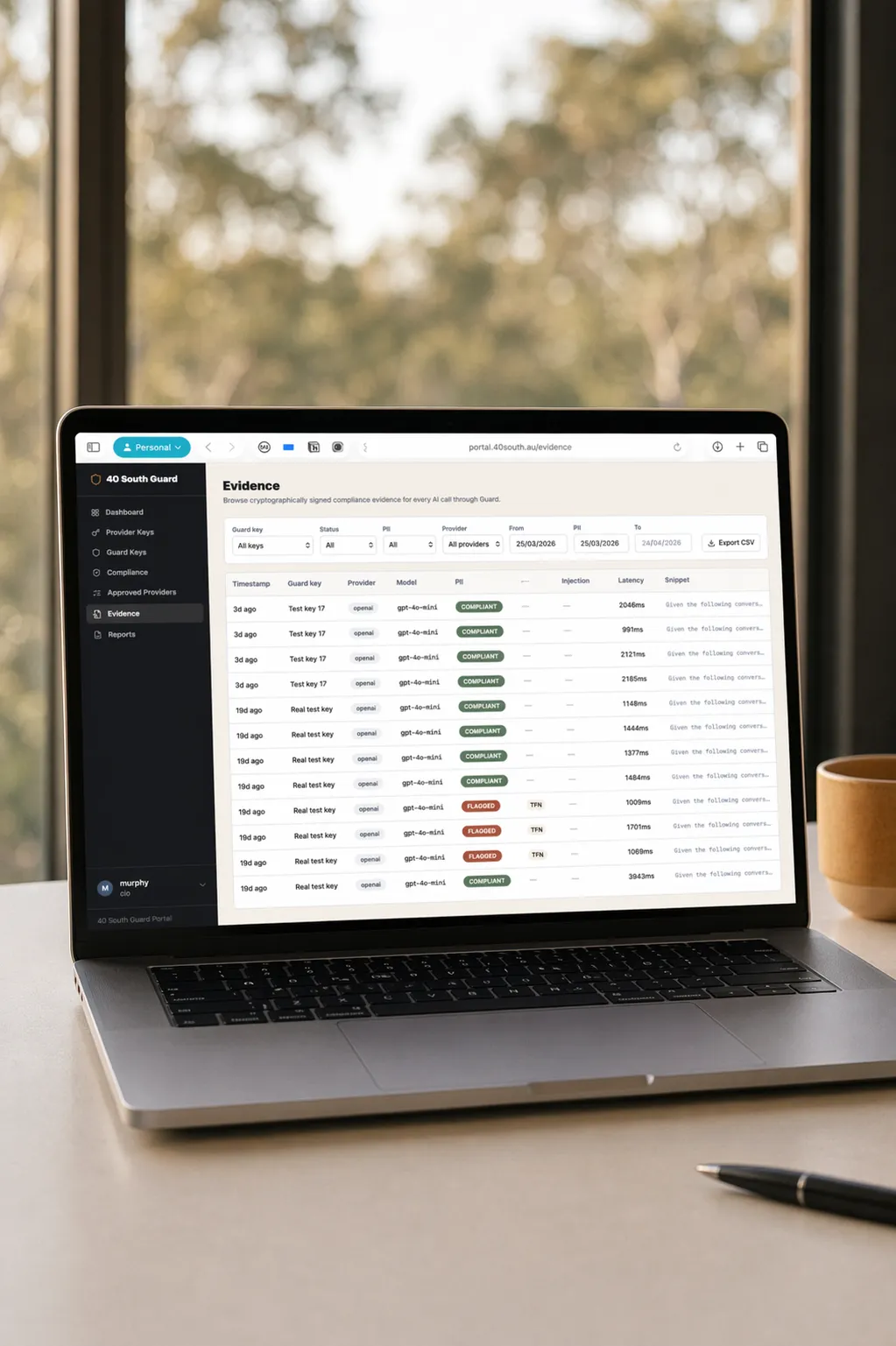
40° SOUTH GUARD
Every prompt.
Every response.
Evidenced by default.
Proof, every call.
Guard is compliance middleware. It sits between your team and whatever AI model they're already using. One API URL change. No infrastructure rebuild. Live in a day. Every call is checked, signed, and logged.
- Scans every prompt and response for Australian PII: TFN, Medicare, ABN, BSB, credit cards, DOB, addresses, phone, email, driver's licences, passports
- Detects hidden instructions inside uploaded documents, a threat no hyperscaler gateway catches
- Per-call cryptographically signed attestation, tamper-evident and audit-ready
- Works with any OpenAI-compatible endpoint: OpenAI, Anthropic, Azure AI, Bedrock, or your own model
- ADM transparency logging and export, ready for December 2026
- 7-year tamper-evident audit trail, exportable as JSON
- Cross-border flagging on every overseas provider call (APP 8 evidence)
- Configurable compliance profiles per team and per use case
Guard covers AI that's been deployed via API: custom apps, RAG tools, agents, and product-embedded AI. Staff using ChatGPT Plus or Microsoft 365 Copilot on personal subscriptions sit outside the API layer; for those, Microsoft Purview or DLP tools apply. Most regulated businesses use both patterns. Guard covers the integration layer, which is where the real compliance risk sits.
HOW IT WORKS
Two lines of config. Every AI call evidenced.
Step 01
Point your AI calls through Guard
Swap the base URL and API key in your app config. Guard works with any OpenAI-compatible endpoint: OpenAI, Anthropic, Azure AI, Bedrock, Gemini, or your own model. Existing code keeps working. Typical integration is under a day.
Step 02
Every call checked, signed, logged
Guard intercepts the request, scans for PII, checks for prompt injection, flags cross-border disclosure, and generates a signed attestation. The call continues to the provider. The response is scanned on the way back. Detection overhead is typically under 50 milliseconds, plus the upstream call.
Step 03
An audit trail your board and regulators can trust
Every call is logged with timestamp, model, user, PII findings, compliance outcome, and regulatory mapping against CPS 234 S14/S15/S16/S17, APP 8, and ADM T1–T4 controls. Export attestations as JSON. Feed them to your GRC platform. Answer a 72-hour notification with confidence.
Detection overhead is typically under 50 milliseconds. Your team won't notice it's there.
WHAT GUARD DETECTS
The threats your current tools don't see.
Guard scans every prompt and every response. Every AI interaction is checked for sensitive data and manipulation attempts before anything leaves your organisation.
Australian PII detection
Catches sensitive data before it leaves your organisation.
Guard scans for personally identifiable information specific to Australian regulations, not just generic patterns.
What happens when PII is found:
Configurable per policy: block the request, mask the sensitive data, or flag and log it. Every detection is recorded in the audit trail with the PII type, location, and action taken.
Guard scans prompts and the content of uploaded files (PDF, DOCX). A staff member uploading a customer document for AI summarisation is covered.
Prompt injection detection
Catches hidden instructions before the AI reads them.
Prompt injection is when someone hides instructions inside content that gets fed to an AI. The AI follows those hidden instructions, potentially leaking data or bypassing controls. Guard catches these before they reach the model.
What Guard detects:
Why this matters for compliance:
If an AI system can be tricked into bypassing controls, your information security controls are ineffective. Under CPS 234, that's a reportable control weakness. Under APP 8, it could result in an uncontrolled cross-border disclosure of personal information.
TRY IT
Verify a signed attestation in your browser.
Guard signs every attestation with ECDSA-P256. The signature verifies without Guard online — your audit archive is regulatory evidence on its own. This demo generates a fresh keypair in your browser and signs a sample attestation.
Keypair generated fresh in your browser and never transmitted. The attestation is synthetic demo data. Production Guard uses Cloud KMS with HSM-managed keys that never touch application code.
GUARD CONNECT
Compliance evidence, where your team already works.
Guard signs every attestation at the moment of detection. Guard Connect delivers it into your GRC, SIEM, or ITSM the same minute — ready to triage, log, and audit. No daily exports. No quarterly reconciliations. No drift between policy and reality.
- Real-time signed webhooks. Every detection fires a signed CloudEvents-wrapped payload to your endpoint in real time, with at-least-once delivery and 90-day replay if your endpoint is offline.
- Approved-provider sync. When your team changes which AI models are allowed in Guard, your asset register updates the same minute.
- Regulatory mapping built in. Every event tags the CPS 234 Section 15 control and the ADM transparency obligation it satisfies. APP 8 cross-border disclosures flagged automatically.
- Replay built in. Missed events queue for replay from your portal. Ninety days of history available via REST for backfill.
- Vendor-neutral. Works with ServiceNow, Archer, OneTrust, MetricStream, LogicGate, Diligent, or anything that accepts a webhook. No connector lock-in.
For the CISO and risk team.
Compliance incidents arrive in your incident-management workflow within seconds of detection. CPS 234 Section 15 evidence and APP 8 cross-border flags arrive already mapped to the obligation they relate to, so triage is immediate.
For the AI governance lead.
Your AI asset register stays current automatically. When someone in your team approves a new model in Guard, your register entry updates the same minute. When a model is removed, the register reflects it. No drift between what your policy says and what's actually running.
For audit and compliance.
Every event is signed, timestamped, idempotency-keyed, and replayable for 90 days. The evidence chain from Guard's attestation through to your GRC record is unbroken — which is exactly what an APRA auditor or a SOC 2 examiner wants to see.
Included in every Guard plan. No additional fee.
THE DIFFERENCE
"AI compliance" software exists.
None of it produces the evidence.
GRC platforms track that a control exists. Hyperscaler gateways check whether outputs are harmful. Microsoft Purview covers Microsoft only. Guard produces per-call proof your controls ran, across every provider.
| Feature |
GRC platforms 6clicks, Protecht, Vanta |
Hyperscaler gateways Cloudflare, Azure, Bedrock | Microsoft Purview | 40° South Guard |
|---|---|---|---|---|
| Sits in the AI request path | ✗ | ✓ | ~ | ✓ |
| Australian PII detection (TFN, Medicare, ABN) with checksums | ✗ | ✗ | ✗ | ✓ |
| Prompt injection detection inside uploaded documents | ✗ | ✗ | ✗ | ✓ |
| Per-call cryptographically signed attestation | ✗ | ✗ | ✗ | ✓ |
| CPS 234 Section 15 runtime evidence | Register-level | ✗ | ✗ | ✓ |
| CPS 230 material service provider oversight | Register-level | ✗ | ✗ | ✓ |
| Cross-provider coverage (Microsoft + OpenAI + Anthropic + others) | ~ | ~ | ✗ | ✓ |
| 7-year tamper-evident audit trail | Register-level | ✗ | ~ | ✓ |
| ADM transparency logging and export | ✗ | ✗ | ✗ | ✓ |
| Market | Compliance program management | Content safety for developers | Microsoft ecosystem | Australian regulatory evidence at inference time |
✓ = supported · ~ = partial · ✗ = not supported
GRC platforms like 6clicks, Protecht, and Vanta are complementary to Guard, not competitive. Guard produces the per-call evidence that their registers can point to. If you already own a GRC seat, use Guard to make what's in it defensible.
INDUSTRIES
Built for Australia's most regulated sectors.
Guard is configured per industry. The compliance rules your business is checked against are specific to your sector, not a generic one-size-fits-all ruleset.
Financial services
Banks, lenders, wealth managers, and AFSL holders face the highest AI compliance obligations in the country. Guard produces the evidence they need.
CPS 234 §15(c): adequate controls must be maintained over third-party information assets, including AI systems accessing customer data.
Health and aged care
Patient and resident data is among the most sensitive in the country. Guard keeps it inside your compliance boundary and produces evidence per call.
APP 11.1: entities must take reasonable steps to protect sensitive health information from misuse, loss, and unauthorised disclosure.
Government and public sector
PSPF, ISM, and the DTA AI Assurance Framework all need evidence of AI handling at classification boundaries. Guard covers that under Australian law.
ISM Control 0714: agencies must implement controls to monitor and log access to systems processing sensitive information.
Superannuation
Super funds face APRA scrutiny on technology risk and material service providers. Guard produces the audit trail your next RSE review will ask for.
SIS Act §52B covenant: trustees must act in beneficiaries' best interests and maintain records of all significant decisions affecting member data.
Legal and professional services
Client privilege, conflict duties, and trust account rules all extend into AI use. Guard covers them, with per-user and per-matter compliance profiles.
Privacy Act APP 8: cross-border disclosure obligations apply the moment client data passes through an overseas AI provider.
Insurance
Insurers handle sensitive personal and health data at scale. Guard monitors every AI interaction against your obligations, including the ICA General Insurance Code.
APRA CPS 234 §15 and ICA General Insurance Code s.9: customer data handled by third-party AI must be subject to oversight controls.
COMPLIANCE COVERAGE
The Australian regulations your business is already obligated to meet.
Guard is built against Australian regulatory frameworks, not retrofitted from US compliance tools. Regulations in force today lead; upcoming obligations follow.
IN FORCE
Privacy Act 1988
Australian Privacy Principles (APPs 1, 8, 11), Notifiable Data Breaches scheme
IN FORCE
APRA CPS 234
Information security for APRA-regulated entities, Section 15 third-party oversight, Section 35 72-hour notification
IN FORCE
APRA CPS 230
Operational risk management, material service provider oversight (commenced 1 July 2025)
IN FORCE
APS 8
AI use in Australian Government
IN FORCE
ISM
Information Security Manual, government classifications
IN FORCE
AFSL obligations
AI in financial advice and dealing
IN FORCE
SIS Act
Superannuation prudential requirements
IN FORCE
ICA General Insurance Code
Insurer obligations on data and communications
COMMENCING DEC 2026
ADM Transparency
Automated decision-making disclosure (Privacy Act APPs 1.7–1.9)
IN DEVELOPMENT
AHPRA guidelines
AI and clinical decision support in health
Regulatory frameworks are updated quarterly. Custom framework mapping available on request.
PRICING
Two tiers. Annual billing. No surprises.
No per-seat charges. No add-ons. Every compliance capability included in both tiers. Choose based on your call volume.
FOR SMALLER TEAMS
Starter
$2,500
/month · $30,000 /yr
Up to 100,000 AI calls/month
- Guard Connect included. Real-time signed webhooks and REST pull into your GRC, SIEM, or ITSM. ServiceNow, Archer, OneTrust, MetricStream, LogicGate, Diligent, or any platform that accepts a webhook.
- Guard proxy and Australian PII detection
- CPS 234 Section 15 and CPS 230 compliance mapping
- ADM transparency logging and export
- 7-year tamper-evident, signed audit trail
- Real-time jurisdiction enforcement
- Compliance dashboard and reports
Onboarding support · Australian team · Built on Google Cloud's managed infrastructure · 7-year audit retention
FOR MULTI-TEAM ORGANISATIONS
Unlimited
$5,500
/month · $66,000 /yr
Unlimited AI calls
- Guard Connect included. Real-time signed webhooks and REST pull into your GRC, SIEM, or ITSM. ServiceNow, Archer, OneTrust, MetricStream, LogicGate, Diligent, or any platform that accepts a webhook.
- Everything in Starter, plus:
- Unlimited AI calls – no monthly cap
- Configurable compliance profiles per team
- Priority onboarding and support
Unlimited teams · Australian team · Built on Google Cloud's managed infrastructure · 7-year audit retention
WHAT YOU'RE REPLACING
$0
Big 4 CPS 234 engagement
$0
Annual compliance FTE cost
$0M
Max civil penalty under ADM laws
GUARD
$30,000/yr
Starter
Less than a quarter of a compliance hire
$66,000/yr
Unlimited
Less than half a compliance hire
START SMALL
Start with a 60-day pilot.
Not sure yet? Start small. We'll deploy Guard on one team or use case for 60 days. If it works, convert to a Starter or Unlimited plan. If it doesn't, walk away with your data and full audit logs. No lock-in.
Full Guard for 60 days
Deployed on one team or use case. Full compliance monitoring, PII detection, prompt injection scanning, and audit trail from day one.
Compliance gap report included
At the end of 60 days, you get a compliance gap report showing your AI exposure, mapped to CPS 234, CPS 230, and the ADM transparency obligation.
No lock-in
At day 60, convert to Starter or Unlimited, or walk away. We'll export your data and audit logs. No questions.
$4,500
Flat fee. 60 days. Includes integration support and policy setup.
Start your pilot →Priced so your compliance budget can approve it without a capital expenditure process.
The $4,500 fee is credited against your first year if you convert to Starter or Unlimited.
COMMON QUESTIONS
Answers to the questions we hear most.
GET STARTED
See Guard in action.
Book a 30-minute demo, or start your 60-day pilot. We'll show you exactly what Guard covers for your industry and what integration looks like.
We'll respond within one business day. No sales pressure.
Australian company · Your data stays under Australian law · No spam
EARLY ACCESS
Guard is live and running in production.
We're onboarding our first compliance teams in financial services and superannuation. If you want to see Guard working against real AI traffic before you commit, book a demo and we'll walk you through the platform.
Hosted in Australia on Google Cloud